 Login
Login
 login / signup





















It all began in a basement. In 1718, John Warren ran the first classes of Harvard Medical School under the institution’s Harvard Hall. Now the third-oldest medical school in the United States, it has centuries of knowledge and curious collections that can all be observed and researched at the largest academic medical library in the world.

While its beginnings were indeed humble, the prestigious medical school has proven its worth in many industry-changing scientific breakthroughs. It was at Harvard that insulin was first introduced to treat diabetes, the small pox vaccine was introduced in the U.S., the first successful kidney transplant, and many more achievements that all other medical schools in the country would be proud to just have one of them.
Unlike other renowned medical schools, Harvard does not have an associated teaching hospital, and instead throughout its history has partnered with various public hospitals. It was in 1810 that the school first moved into Boston proper, and would move another four times before setting up at its present location in the Longwood Medical area in 1906. As the decades passed at the same location in Boston, which must have felt like a novelty, school officials felt nested enough that a library building was planned to house its ever growing collection of medical resources and research.
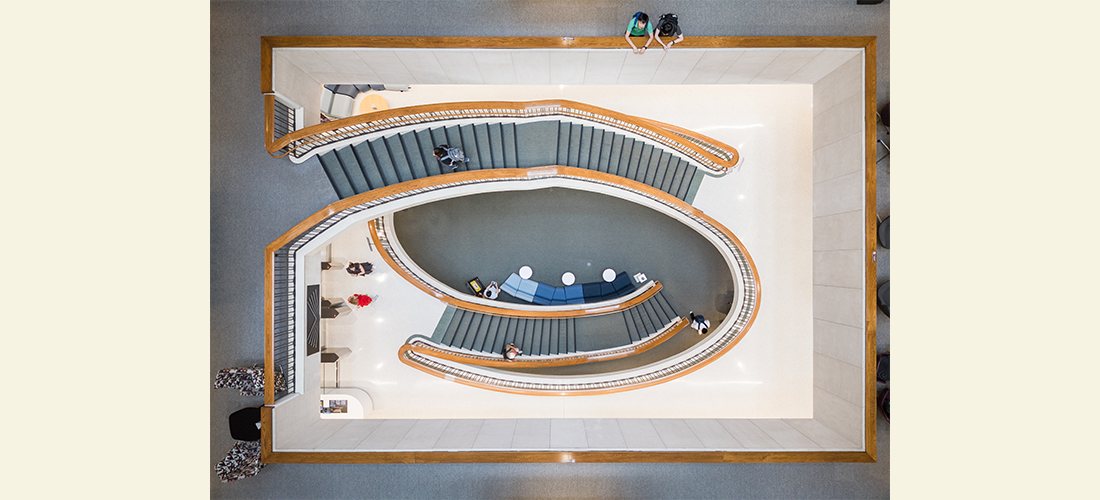


Since 1958, the Francis A. Countway Medical Library, constructed in the Brutalist style, serves not only Harvard’s medical students but also houses many historical collections of the school, including the Warren Anatomical Museum. In 2019, the concrete structure began a major renovation with architecture firm Shepley Bulfinch at the helm. A notable feature of the new construction was a bridge adding a new entrance to the building from Huntington Ave., as the original 1958 design called for, and reconnecting the medical building to the surrounding community.