Through our Lens:

India

Partner

We’ve all heard of the Taj Mahal, and perhaps Hawa Mahal and the many famous mahals in between. But the real magic of Agra and Jaipur is found in the spaces between the postcards – down the quiet gallis, behind carved doorways, and on rooftops where you’ll more likely find the best views. So with our BFFs at Skyscanner, we’re back for round two (after Roaming around Rome) and exploring these storied cities the only way we know how: following the detours for a more off-the-beaten-path itinerary. Consider this your loosely plotted route through stepwells, kite markets, hidden courtyards, and a few well-timed stops for chai and samosas along the way. Chalo!

Mumtaz Mahal died in 1631 giving birth to her fourteenth child, and her husband Shah Jahan avoided royal affairs for a week, gave up music and lavish dressing for two years. Then he commissioned a monument with materials from across continents — lapis lazuli from China, turquoise from Tibet, sapphire from Sri Lanka. Over 20,000 workers and 1,000 elephants spent twenty-two years constructing what would become the world’s most famous mausoleum, the Taj Mahal.

Learn More

Dharmapuri, Forest Colony, Tajganj, Agra, Uttar Pradesh 282001, India

Mehtab Bagh

Emperor Babur built Mehtab Bagh in the early 1500s as the last of eleven Mughal gardens along the Yamuna, long before anyone dreamed of the Taj Mahal. A century later, Shah Jahan identified it as the best place to view his monument and added an octagonal pool that captured moonlight and the Taj’s reflection. It remains one of the best spots to view the Taj Mahal. It got the name Moonlight Garden because it was mostly used in the cool of the night. Floods in the early 1900s buried it under sand — until a 1994 excavation searching for the rumored Black Taj Mahal discovered the charbagh complex instead. Talk about a happy accident!

Nagla Devjit, Agra, Uttar Pradesh 282001, India

Containing three entrances, the Taj Mahal Mosque welcomes visitors with its stately exterior. The main entrance includes an iwan, or arched doorway, adorned in black marble inscriptions from the Quran. Decorative flowers carved into the marble, a technique known as pietra dura, also envelop the entranceway. Two smaller entrances are on either side of the center, and the mosque is topped by three domes.

Learn More

52GR+279, Dharmapuri, Forest Colony, Tajganj, Agra, Uttar Pradesh 282001, India

Ganeshi Lall Emporium

In 1845, when most businesses were still figuring out how to operate in one city, Indian politician Ganeshi Lall opened showrooms in Agra, Calcutta, Cairo, and New York. The emporium — one of the oldest jewelers in Agra — specializes in Zardozi, Persian gold embroidery that flourished under Mughal emperors who understood that thread and metal could tell stories fabric alone never could. Inside, a miniature of Shah Jahan’s Peacock Throne. The throne was started in 1000 AD and cost twice as much as the Taj Mahal!

13, Mahatma Gandhi Rd, Chhipitola, Idgah Colony, Agra, Uttar Pradesh 282001, India

Itmad-ud-Daula

Nur Jahan built this tomb for her father, a Persian exile elevated to Pillar of the State. He nearly abandoned her as an infant, too poor to feed her, but her persistent wails changed his mind. The baby brought such luck that he found a caravan straight to Emperor Akbar’s court. Constructed between 1622 and 1628, the tomb (called Baby Taj — aw!) marks the moment Agra traded red sandstone for white marble and pietra dura inlay. Its marble jali screens are considered the most delicate in the city — finer, it is said, than even the (adult) Taj Mahal itself!

Moti Bagh, Agra, Uttar Pradesh 282006, India

Chand Baori

King Raja Chanda of the Nikumbha Dynasty built this stepwell between 800 and 900 AD, descending 13 stories and 100 feet into the earth. It contains 3,500 perfectly symmetrical steps. The precise geometry meant that as many people as possible could access water simultaneously during droughts. The bottom stays roughly 5-6 degrees cooler than the surface, transforming the stepwell into a subterranean refuge during Rajasthan’s brutal summers. The site could be called cinematic: the steps are so steep and disorienting that the well appeared in “The Dark Knight Rises” as the prison pit where Bruce Wayne is held.

Chand Baori, Rajasthan, India

The Leela Palace Jaipur

Opened in 2021, The Leela Palace Jaipur brings royal grandeur to the edge of the Aravalli Hills. Built from pink sandstone and inspired by Rajput architecture, the palace-style hotel features hand-painted ceilings, marble courtyards, and sweeping arches worthy of a maharaja. Unlike Jaipur’s historic palaces, this one was built entirely as a hotel—so every guest gets the royal treatment and tranquility away from the bustling city center. Ahhh.

Jaipur-Delhi Highway, NH 11, Kukas, Jaipur, Rajasthan 302038, India

Amer Fort, both royal palace and military stronghold, stands on a hill over Maota Lake. Construction of the impenetrable red sandstone and marble began in the sixteenth century at the direction of Maharaja Man Singh I, a commander in the Mughal emperor Akbar’s army. The fort rises on four levels, each with its own courtyard. Inside, among the opulent rooms are the Diwan-e-Aam, or Hall of Public Audience, resplendent with mosaic glass works, where the king met his ministers and welcomed common men to hear their requests. The Sukh Niwas, or Hall of Pleasure, even featured an ancient method of air-conditioning, where air passed over channels of perfumed water to keep the palace cool.

Learn More

Devisinghpura, Amer, Jaipur, Rajasthan 302001, India

Anokhi Museum

Faith Singh founded Anokhi in 1970, just as Rajasthan’s block printing tradition was being edged out by synthetics and speed. She began rescuing hand-blocked textiles from artisans abandoning the craft, transforming them into contemporary fashion that kept heritage—and livelihoods—beautifully intact. Thirty years later, she opened the Anokhi Museum of Hand Printing in a restored 16th-century haveli. Inside, carved wooden blocks meet jewel-toned dyes like indigo and turmeric, and visitors are treated to live demonstrations by expert artisans!

Anokhi Haveli Kheri Gate, Amer, Jaipur, Rajasthan 302028, India

Monkey Temple

Galta Ji, The Monkey Temple, is home to hundreds of monkeys who spend their days causing trouble across Jaipur before returning home each evening — a commute National Geographic found compelling enough to document in the series Monkey Thieves. It’s also home to seven sacred pools that legend says will never run dry. Worth noting: despite all the monkeys, Galta Ji is dedicated to Ganesha, the elephant god. Not Hanuman, the monkey god!

Sisodiya road, Lal Dungri, Jaipur, Rajasthan 302003, India

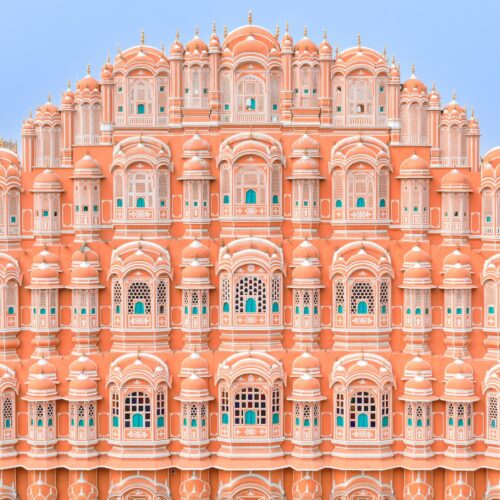
Maharaja Sawai Pratap Singh built this five-story honeycomb in 1799 so royal women could watch street festivals without being seen — purdah with a view. The 953 jharokha windows weren’t just for discretion: they create a venturi effect that funnels wind through the palace, dropping the temperature without mechanical intervention. It was designed to resemble Krishna’s crown, complete with fluted pillars mimicking his flute. The architect, Lal Chand Ustad, had no formal training but understood airflow better than most engineers — and knew that watching the world unseen required architecture as intricate as lace. Now, that’s pretty cool.

Learn More

Hawa Mahal Rd, Badi Choupad, J.D.A. Market, Pink City, Jaipur, Rajasthan 302002, India

City Palace is a complex in Jaipur, the capital of the Rajasthan state, India, and was once the seat of the Maharaja of Jaipur, the head of the Kachwaha Rajput clan. The complex is made up of multiple buildings including The Chandra Mahal palace which now houses a museum, but the greatest part of it is still a royal residence.

Learn More

Gangori Bazaar, J.D.A. Market, Pink City, Jaipur, Rajasthan 302002, India

The Johri

Tucked inside Jaipur’s storied Johari Bazaar, The Johri is a five-suite boutique stay that feels more like an impeccably dressed friend’s ancestral home than a hotel. Built within a restored haveli, it layers hand-painted walls, jewel-toned textiles, and marble details with the kind of restraint that whispers rather than shouts. Downstairs, a courtyard pool offers a cool reprieve from the Pink City bustle, while the rooftop restaurant serves seasonal Rajasthani fare with a view.

3950, MSB Ka Rasta, Johri Bazar, Ghat Darwaza, Jaipur, Rajasthan 302003, India

Built between 1724 and 1730, they each contain complex, large-scale geometric devices resembling art installations (particularly when being minded by a chromatically synchronized guard). The telescope had been in use for over a century by then, but King Maharaja Sawai Jai Singh II did not believe that any small device made of brass—whose parts would wear and erode—could deliver precise measurements or an understanding of celestial objects. Instead, his observatories were built using stone and masonry. Given his capacity to think huge, his “instruments” run as tall as 90 feet high. The Samrat Yantra is a classic example: a sundial that uses a gigantic triangular gnomon (the part that casts a shadow) to track the rate of Earth’s movement.

Learn More

Malve Nagar, J.D.A. Market, Pink City, Jaipur, Rajasthan 302002, India

Gem Cinema

Gem Cinema opened on July 4, 1964, when its founder Maniram Kasliwal’s grandson laid the foundation stone in 1960. Best known for its 10am Hollywood shows, particularly James Bond films, the theatre shut down in 2005 when multiplexes took over. It sat locked for 15 years, a silent witness to bygone glitz and glamour. In what seems like a perfectly cinematic twist, the projectionist who’s been looking after the Bauer Arc Lamp Projectors since 1962 returned to fire up the cinema’s equipment to reopen for the Jaipur International Film Festival in 2019!

Mirza Ismail Rd, Bapu Bazar, Biseswarji, Jaipur, Rajasthan 302003, India

Originally known as Prem Prakash Talkies, this formerly single-screen theater is one of the oldest multiplex movie houses in Jaipur. Opened in 1954, the theater is one of several businesses run by the prominent Golcha family, which has always projected an unusually strong devotion to film. Nostalgic moviegoers worldwide can appreciate that the beckoning theater, located a stone’s throw away from Jaipur’s City Palace, has maintained its 1950s style despite multiple renovations and opportunities to “modernize” it. The pink concrete facade welcomes viewers into a massive marble- and tile-lined lobby with two grand staircases stretching up beyond two faithfully retro ticket counters.

Learn More

Chaura Rasta Rd, New Gate, Bapu Bazar, Pink City, Jaipur, Rajasthan 302003, India

Raj Mandir

Mehtab Chandra Golcha opened Raj Mandir on June 1, 1976, a decade after construction began. His dream was a theater that combined luxury, architecture, and entertainment unlike any other in India. Architect W. M. Namjoshi designed it in Art Moderne style, a late Art Deco aesthetic rarely used in India. Nine stars on the exterior signify nine gemstones in the Navaratna style, an homage to the owners’ jewelry house — the Bhuramal Rajmal Surana group still operates it today. The cinema holds a legendary 25-year history of selling out every single day!

C-16, Bhagwan Das Rd, Panch Batti, C Scheme, Ashok Nagar, Jaipur, Rajasthan 302001, India

Abode Hotel

Set within a restored haveli just beyond Jaipur’s busiest bazaars, Abode Jaipur trades palace-scale grandeur for intimate, design-forward charm. Handcrafted tiles, carved stone details, and bold Rajasthani textiles give each room its own personality—layered, local, and just a touch theatrical. A leafy courtyard and breezy rooftop terrace offer quiet corners above the Pink City’s hustle and bustle.

211, Kishanpole Bazar Rd, Modikhana, Jaipur, Rajasthan 302003, India

Dera Mandawa

When Thakur Jait Singh Ji of Mandawa needed a place to crash during his 1885 visits to the Maharaja of Jaipur’s court, he built himself a proper city pad. The hundred-year-old wooden carved pillars couldn’t be replicated today—the kind of craftsmanship that makes modern contractors weep. Rajasthani monuments were rarely constructed at one go; each generation added new wings, rooms, and arches in whatever architectural style was trending at the time. Now run by his great-grandson, Thakur Durga Singh ji, the family residence functions as an eleven-suite boutique hotel where milk comes from the family’s own herd of cows and a biogas plant runs on cow pats.

New Mandawa House, Sansar Chandra Rd, Adjoining Punjab National Bank, Pink City, Jaipur, Rajasthan 302001, India

Eight kilometers outside Jaipur’s storied walls sits Rambagh Palace — a property with quite the glow-up story. Built in 1835 as a humble home for the queen’s favorite handmaiden, it was upgraded to a royal hunting lodge in 1887 when the surrounding forest made it the perfect spot for a little wild pursuit. Apparently, once you go palace, you never go back. By the early 20th century, renowned architect Sir Samuel Swinton Jacob gave it a full royal makeover, transforming the lodge into a grand residence fit for the Maharaja of Jaipur himself. Maharaja Sawai Man Singh II called it home until 1957 — then, in a move that would make any real estate agent weep with joy, converted it into a luxury hotel.

Learn More

Bhawani Singh Rd, Rambagh, Jaipur, Rajasthan 302005, India

Albert Hall

Jaipur’s grandest Indo-Saracenic showpiece, Albert Hall Museum rises from Ram Niwas Garden like a palace that decided to major in art history. Completed in 1887 and named for the Prince of Wales (later King Edward VII), its ornate arches and domes house everything from miniature paintings to an Egyptian mummy—because why stop at one continent? By day, it’s a masterclass in symmetry and sandstone; but by night, the museum is illuminated in golden light that makes the domes and arches glow like something from another century — which, technically, they are.

Ram Niwas Garden, Ashok Nagar, Jaipur, Rajasthan 302004, India

Built in 1729 by Maharaja Sawai Jai Singh II, Rajmahal Palace remained in royal hands for nearly 300 years—welcoming generations of Jaipur royalty and even Queen Elizabeth II. Designed as a focal point for all of Jaipur to admire regardless of class, its frescoed walls, airy courtyards, and delicate jharokhas frame every view. In 2009, the family opened 14 suites to guests. Polo trophies and family portraits remain on display—and the royals still live here, quietly keeping an eye on the place, just as they have for nearly three centuries.

Learn More

Sardar Patel Marg, Shivaji Nagar, Jaipur, Rajasthan 302001, India

Polo Palladio

Tucked inside the historic Rajasthan Polo Club, Polo Palladio offers a stylish break from the thundering hooves. Designed by Dutch designer Marie-Anne Oudejans, the restaurant pairs Italian dishes with a setting of pink arches, striped umbrellas, and candlelit courtyards. After an afternoon watching riders chase the ball across the field, it’s the perfect place to trade polo commentary for pasta and a spritz.

VRX3+M72 Ambedkar Circle, Bhawani Singh Rd, Rambagh, Jaipur, Rajasthan 302015, India

Often referred to as “the most colorful door in India”, Patrika Gate greets both passing cars and passersby from Jawahar Circle in Jaipur. Built in 2016, the Gate contains a colorful cacophony of hues depicting the history of Jaipur, India’s famed Pink City. Considered by locals to be Asia’s largest circular park developed on a highway traffic circle, Jawahar Circle is located near Sanganer Airport. Developed by the Jaipur Development Authority, the park encompasses a circumference of 4,658 feet (1,420 m) and includes pathways, a fountain, rose gardens in addition to its towering gate.

Learn More

RRR2+JHC, Jaipur, Rajasthan 302018, India

Loading Places

Log in

or

Enter Your New Password