

 Login
Login
 login / signup













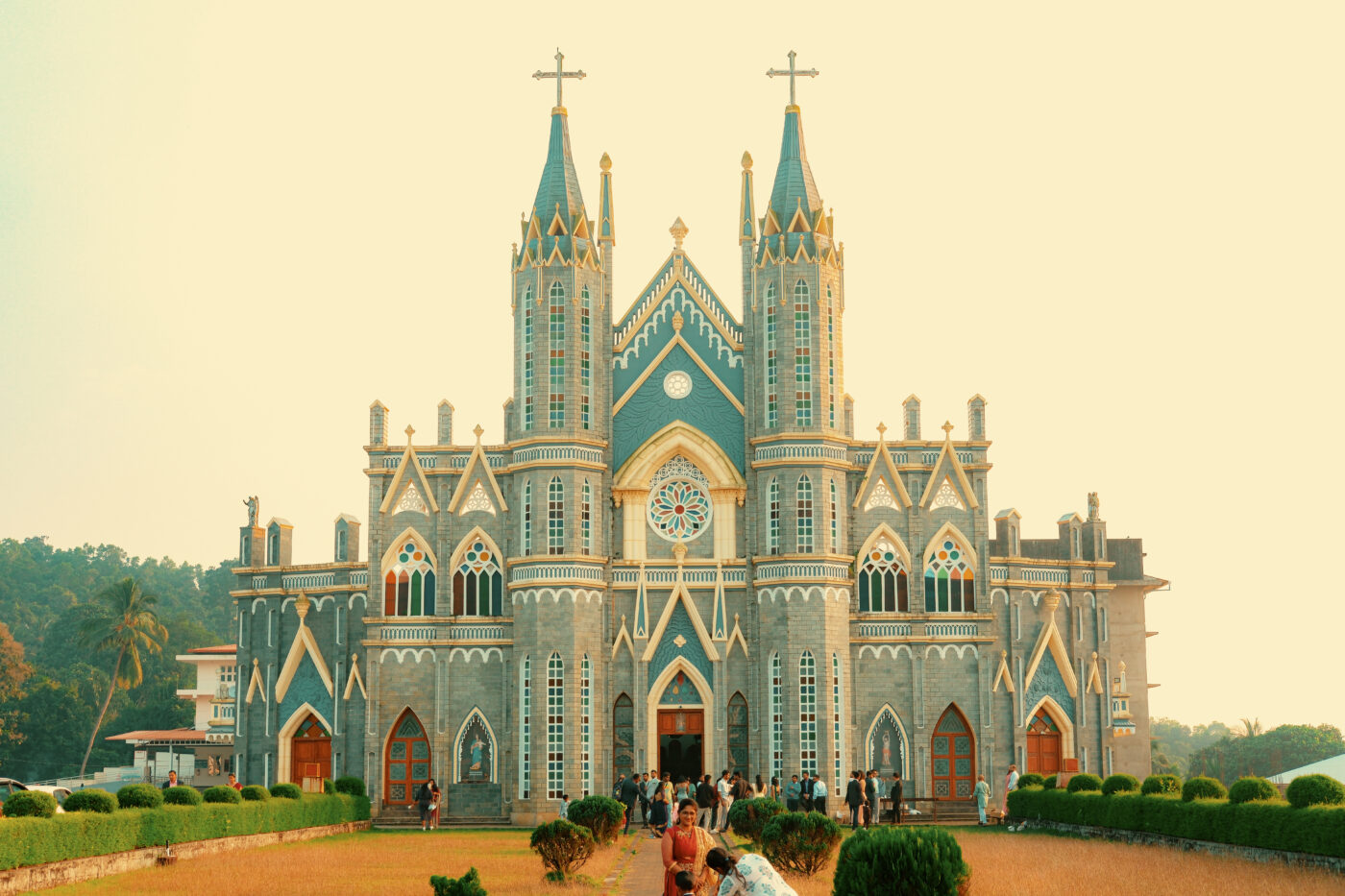


This isn’t Disneyland – it’s a Catholic basilica in Karnataka that looks like it was designed by someone who studied Gothic cathedrals and decided the hills of South India needed a fairytale castle.
The St. Lawrence Minor Basilica in Karkala rises from the green hills with pointed arches, soaring verticality, and twin 90-foot belfries painted in shades of blue and orange. The facade has been compared to a Disney castle often enough that the comparison has become unavoidable. Inside, enormous stained glass windows – some of the most beautiful in India – cast colored light across the nave. The architecture incorporates Christian, Hindu, and Muslim elements, built in 2001 as a deliberate symbol of communal harmony.
Over a million pilgrims visit each year, many from faiths beyond Catholicism. In the Tulu language, St. Lawrence is called “Karkalada Dever” – the god of Karkala. Hindus, Muslims, and Christians come to seek his darshan, fulfill vows, or simply witness the spectacle of a 3rd-century Roman martyr who has become a local deity.
The church exists on this particular hilltop because of an earlier miracle – or at least, a story about one.
In 1839, devotees were searching for a site to build a new church. They carried a one-foot wooden statue of St. Lawrence across Ramasamudra lake and up Parpale Hill. When they found a spring, they set the statue down to drink. When they tried to lift it again, the statue wouldn’t move – as if it had rooted itself to the ground. The priest interpreted this as divine instruction and built the church on that exact spot. The statue, reportedly the same one, is now displayed in a glass case inside the basilica.
The current building dates to 1900, when Rev. Fr. Frank Pereira commissioned the structure facing north. But the site’s history stretches back further, through cycles of destruction and rebuilding. Christians in the region suffered under Tipu Sultan between 1780 and 1799. Many were taken captive to Seringapatam, and some were forced to convert to Islam. The original parish church, located seven kilometers away, was demolished by Tipu Sultan’s forces. After the captives returned, they built a thatched roof church in 1801. The site was moved to Parpale Hill in 1839 – the spot where the statue refused to budge.
The church has been purported to be the site of many miracles since 1759. On April 26, 2016, Pope Francis elevated the shrine to Minor Basilica status, making it the 22nd basilica in India and the second in Karnataka. The proclamation ceremony on August 1, 2016 drew three Cardinals, 40 Bishops, over 300 priests and nuns, and approximately 15,000 devotees.
Today the basilica stands as both pilgrimage site and architectural curiosity – a Gothic fantasy in South India, built on a hill chosen by a stubborn wooden saint, visited by people of multiple faiths seeking blessings from a Roman deacon martyred in 258 AD. It looks like a castle from a theme park. It functions like a living shrine where boundaries between religions blur and a saint becomes a god.
 13.205966, 74.9720868

