
 Login
Login
 login / signup














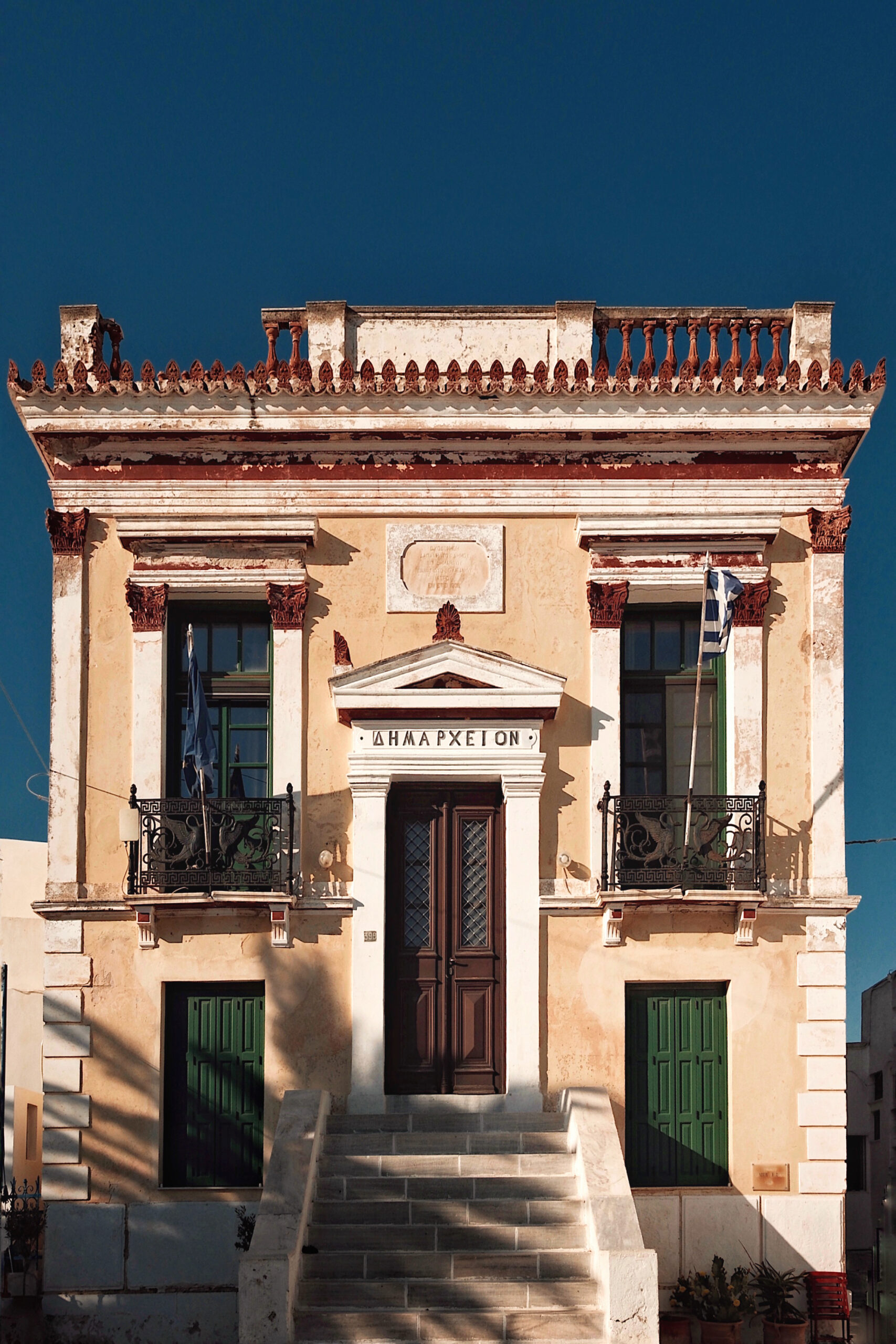


By 1904, Ernst Ziller had already designed Greece’s most photographed buildings. The German-born architect had given Athens its Presidential Mansion, its National Archaeological Museum, and a mansion for Heinrich Schliemann so extravagant it was nicknamed Iliou Melathron, the Palace of Troy, after the city its owner had spent a career digging up. Over roughly five decades, Ziller put his name on something like 500 structures across Greece, theaters and markets and royal palaces, enough to make him the de facto architect of an entire national style.
That same year, he sent plans to Serifos, a Cycladic island most visitors still have to look up. The island’s capital sits on a rocky peak roughly 200 meters above the sea, laid out in the dense, winding pattern typical of Cycladic hilltop villages, originally built that way to disorient pirates who might otherwise have an easy time finding their way to anything worth stealing. Into this maze, Ziller dropped a neoclassical town hall, the kind of building you’d expect fronting a government square in Athens, not anchoring the only open public square in a village designed specifically to avoid having open public squares.
It worked. Pano Piatsa, the plaza the town hall now commands, remains the rare breathing space in a settlement otherwise built to be confusing on purpose. Locals and visitors fill its café chairs in the shadow of a building that has, by any reasonable architectural standard, no business being there.
Ziller spent his career designing grandeur for other people. Less of it stuck to him personally: he went bankrupt in 1893, lost his own mansion at auction, and died in 1923 buried in Athens’ First Cemetery, in a plot that, by some accounts, was eventually reassigned for lack of paid maintenance fees. Serifos got a square. Ziller got considerably less.
 37.1556428, 24.5059681